
Projects
The AI Association conducts educational and exploratory projects that enable students and interested members to learn artificial intelligence and machine learning through hands-on collaboration.
Kreuzsteinbad pool visitors forecasting
In this ongoing project with Stadtwerke Bayreuth, members of the AI Association forecast visitor numbers at its outdoor pool (Kreuzsteinbad), so that lifeguard rosters can match the demand. Rosters are fixed two weeks in advance, so the team aims to predict that far ahead whether a day will be quiet, average or busy. The team works using daily visitor counts from past years, and the weather plays a big part.
Contributors:
- Nico Höllerich
- Pascal Lange
- Laura Hafner
- Mina Mohammed
- Jamil Shihada
- Simon Reif
- Pascal Fechner
- Renato Mio
This project is in progress.
Rebuilding our website with agentic AI
Four members with no coding experience rebuilt the association’s website together with one web developer and an AI coding agent. Over four sessions, the group worked out the concept, set up coding agents and learned the basics of GitHub, then built and refined the site. The team decided what to build, the agent wrote the code, and the developer reviewed major changes. The non-coders now run this workflow on their own. Lessons learned: the hard part became deciding what to build, version control was harder to learn than prompting, and one experienced reviewer is still needed.
Poster presented at the AI Day 2026 (PDF)
Contributors:
- Mohammad Ahmad
- Laura Hafner
- Mina Mohammed
- Tizian Küffner
- Jamil Shihada
- Pascal Fechner
- Renato Mio
This project was concluded and is currently closed.
ML4Mensa
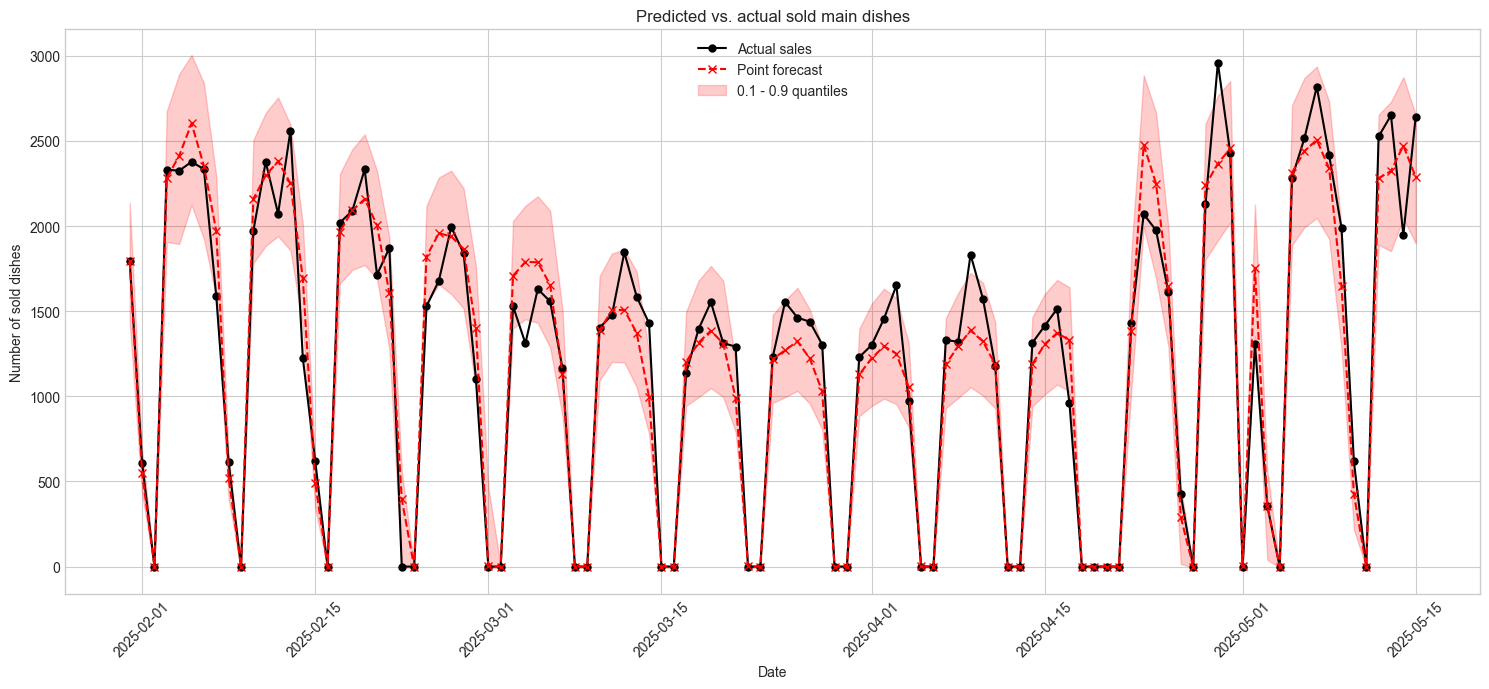
In this project, members of the AI Association collaboratively explored how machine learning methods can be applied to real-world tabular data. Using anonymised historical cafeteria transaction data provided by the university services, team members learned and applied techniques for data preprocessing, feature engineering, the comparison and evaluation of different machine learning models, and the interpretation of model behaviour and limitations.
The next figure shows the predictions of the final ML model compared to the ground truth data:
Media coverage:
- Bayreuther Tagblatt (in German)
- Kurier (in German)
- inFranken.de (in German)
- UBT press release in English and in German.
Contributors:
- Pascal Fechner
- Nico Höllerich
- Renato Mio
- Felicitas Feick
- Pascal Lange
- Mohammad Ahmad
This project was concluded and is currently closed.
Coffee consumption forecasting
This project focused on learning sequential modelling techniques using time series data. Based on historical sales data of hot beverages from the university cafeteria, members jointly investigated: how time-dependent data can be structured for machine learning, the use of recurrent neural networks (such as LSTM models), and how different modelling assumptions influence predictions.
Contributors:
- Ivan Khrop
- Pascal Fechner
- Andreas Karasenko
- Felicitas Feick
- Renato Mio
- Gianluca Pani Casanova
- Franz Erhard
- Henri Berntgen
- Frederik Hornung
- Nico Höllerich
- Tom Zeilmann
This project was concluded and is currently closed.